Launch offer — valid today only

📄 Digital book in PDF · read it on your phone or print it

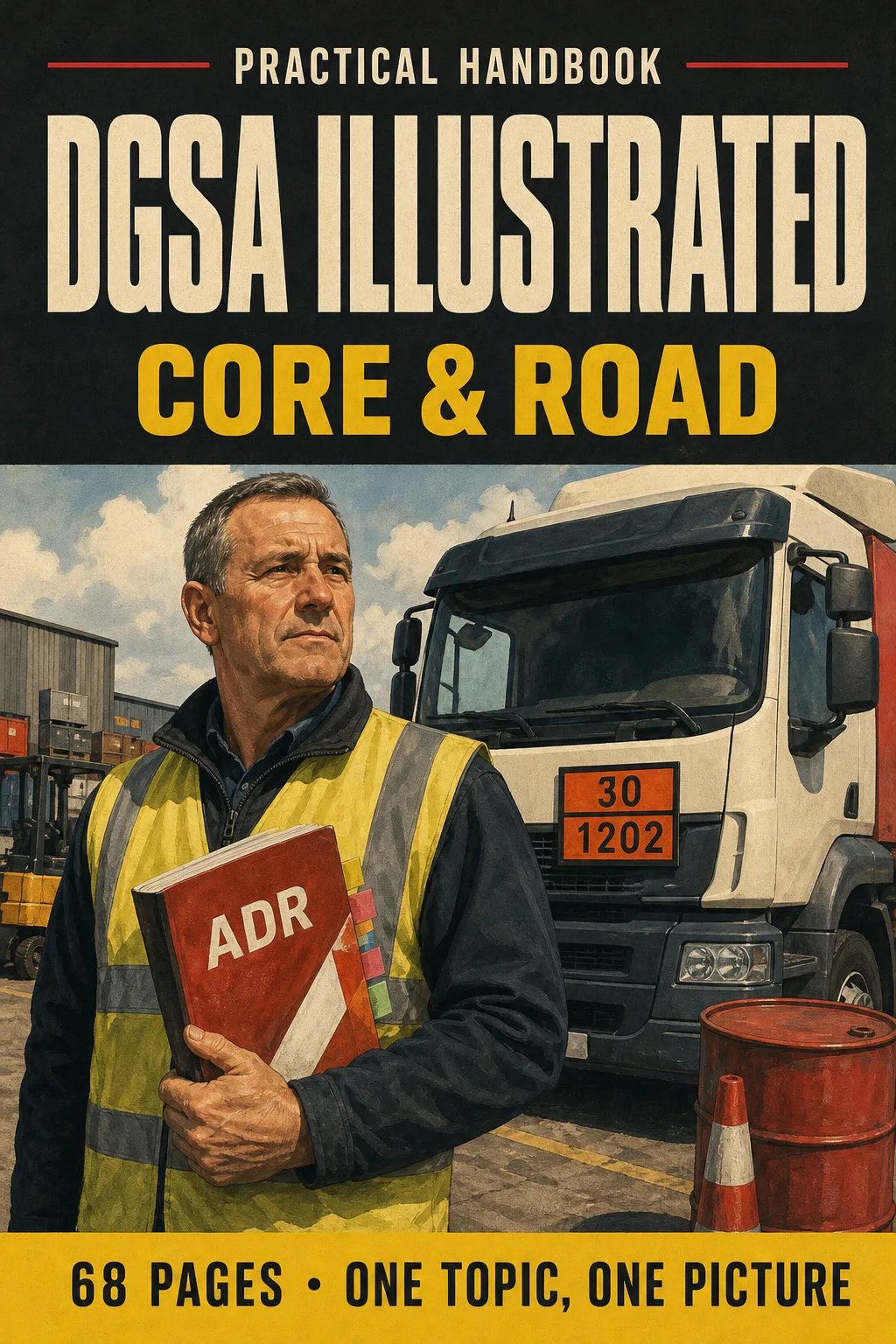
ADR and the DGSA Core & Road Modules in Drawings From UN Number to Answer in 8 Steps, Always in the Same Order

The 9 classes, Table A's 20 columns, UN packaging marks, labels and orange plates, the 1.1.3 exemptions, 1.1.3.6 points, transport documents and the adviser's duties. Each topic has its own page: the drawing first, then what you need to remember. 68 illustrated pages.

GET DGSA ILLUSTRATED: CORE & ROAD

🔒 Secure checkout · PDF by email · 30-day guarantee

Every topic, its own pageEach ADR rule drawn, with the explanation beside it
68 illustrated pages9 parts, from the map of ADR to the worked case studies
Up-to-date sourcesADR 2025 (in force until the end of 2026) and the CDG Regulations 2009 as applied in Great Britain
PDF by emailFormat

Look Inside the Book

Every page has one big drawing and a box with the columns, limits and steps you need to know:

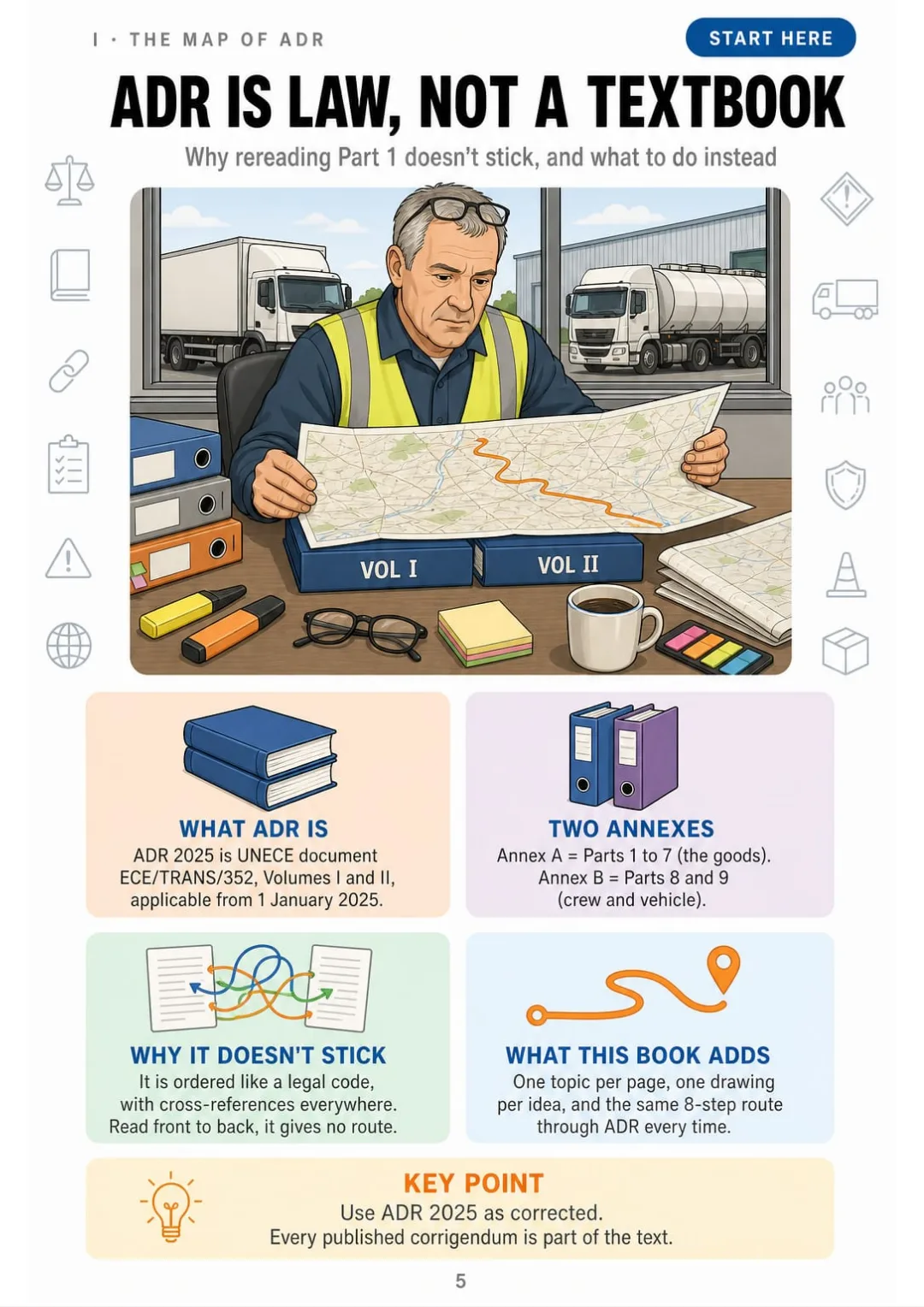
ADR 2025 (ECE/TRANS/352): Annex A Parts 1-7, Annex B Parts 8-9
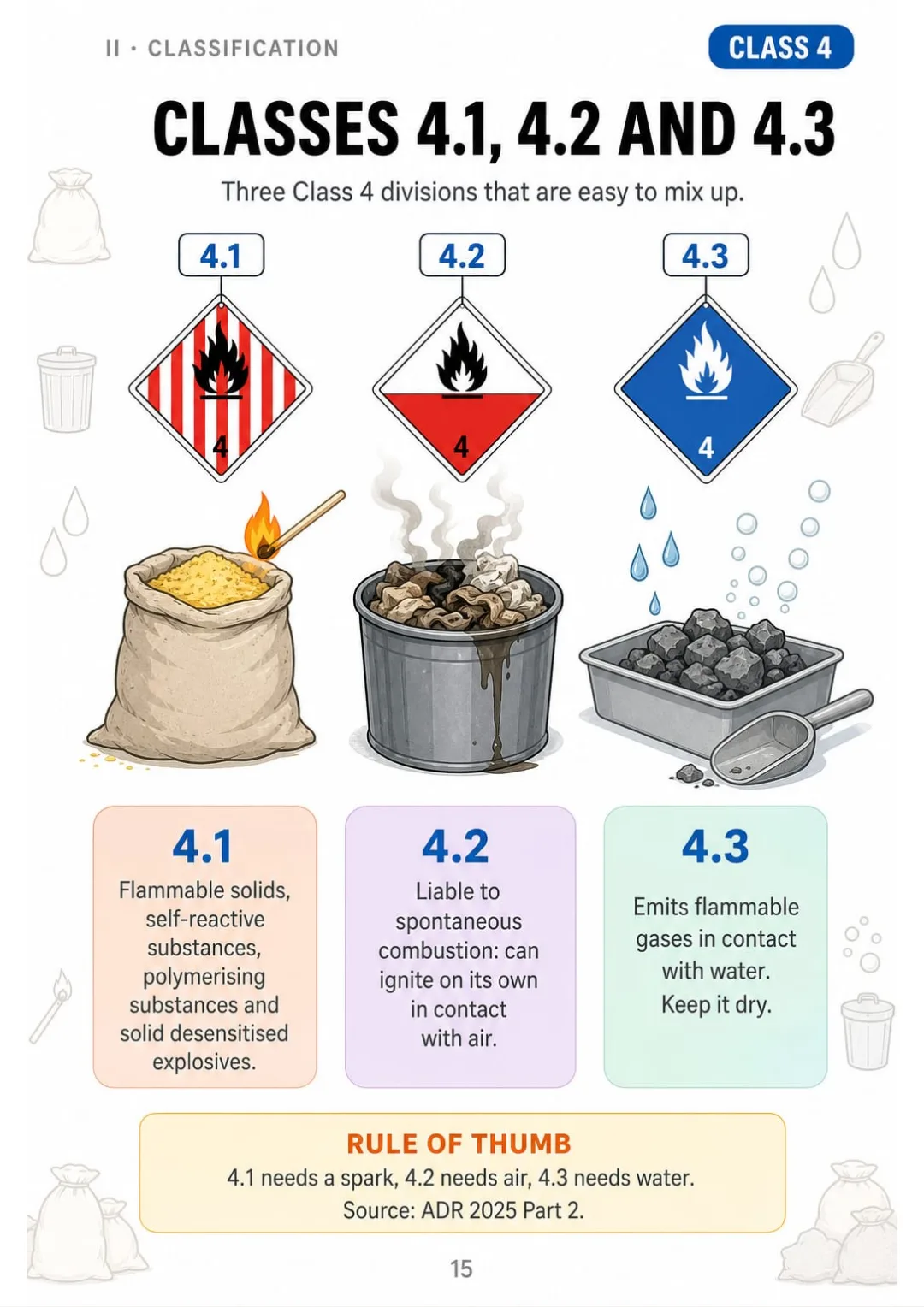
4.1 burns easily, 4.2 ignites in air, 4.3 gives off flammable gas with water.
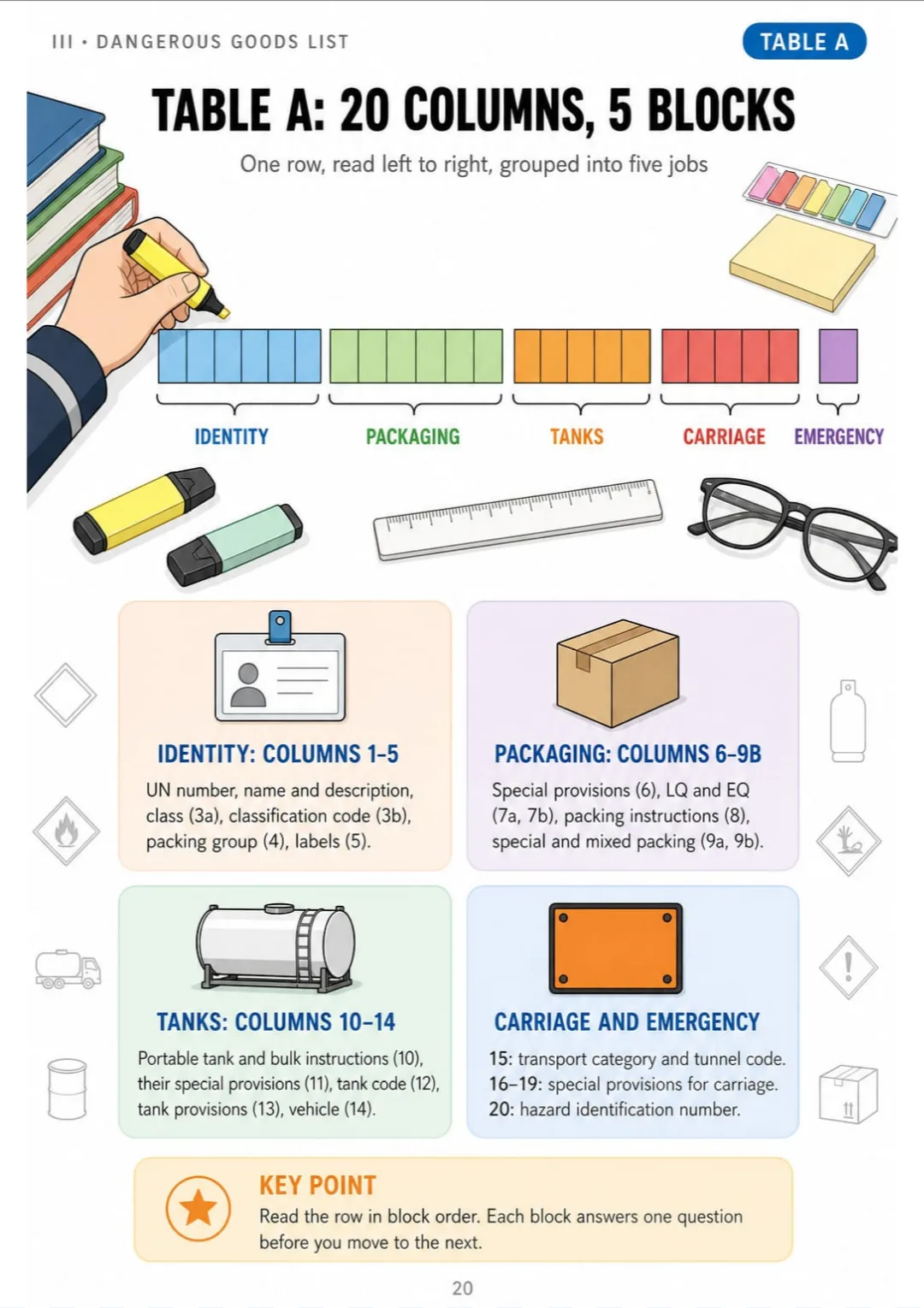
Table A columns 1 to 20, grouped: identity, packaging, tanks, carriage, emergency.
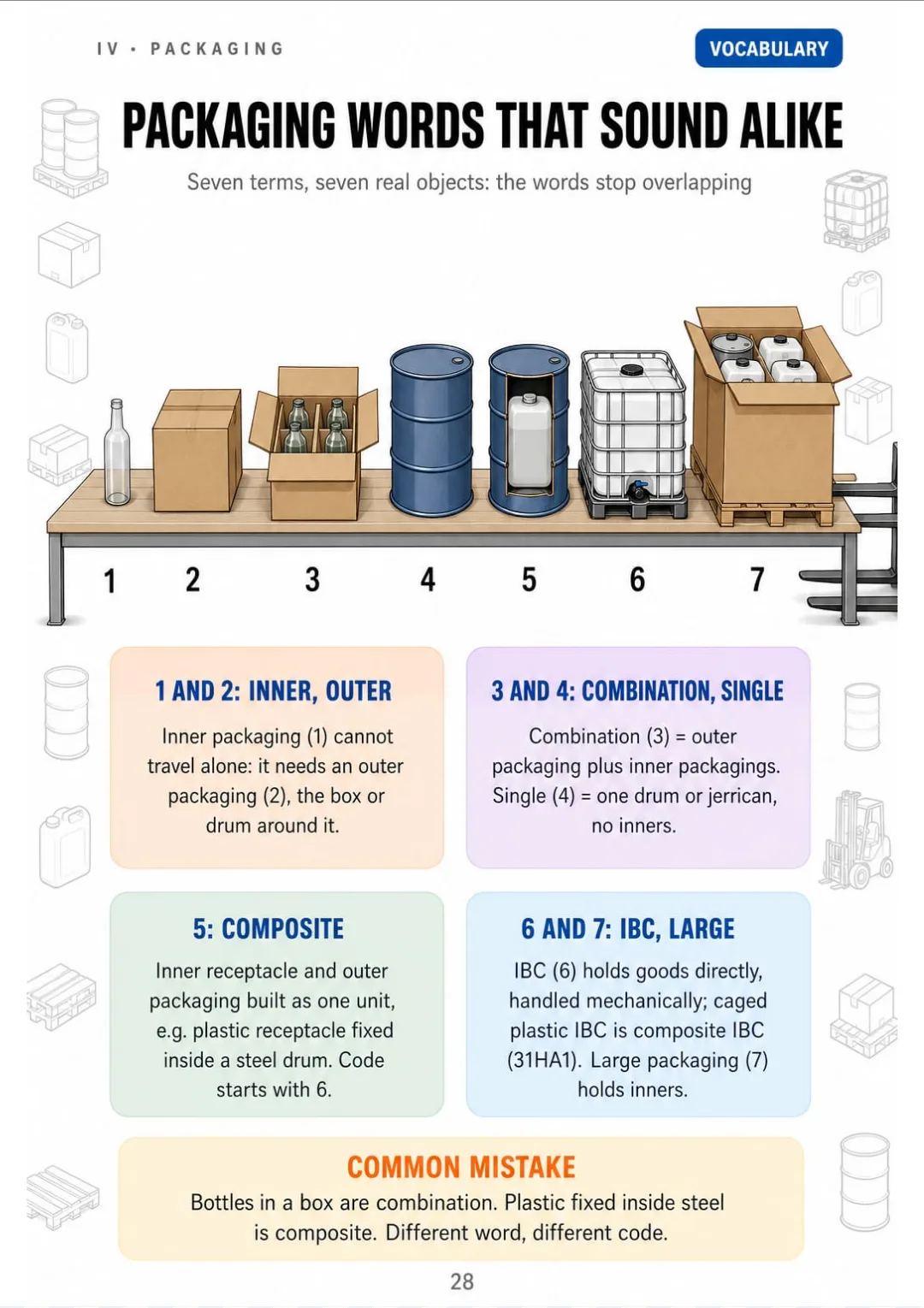
Inner, outer, combination, single, composite, IBC and large packaging: seven objects in a row.
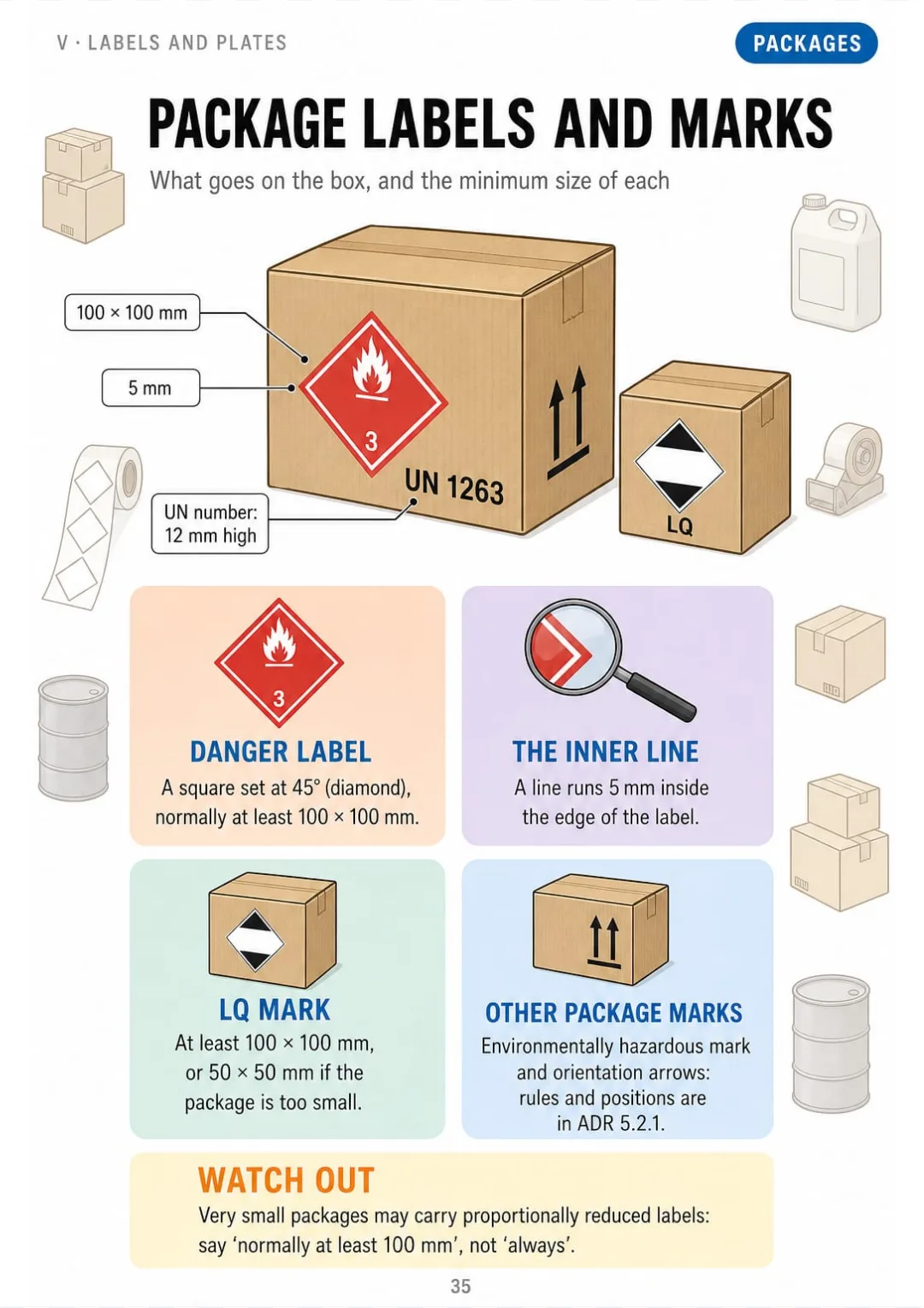
Package danger labels: diamond, normally at least 100 × 100 mm, line 5 mm inside the edge
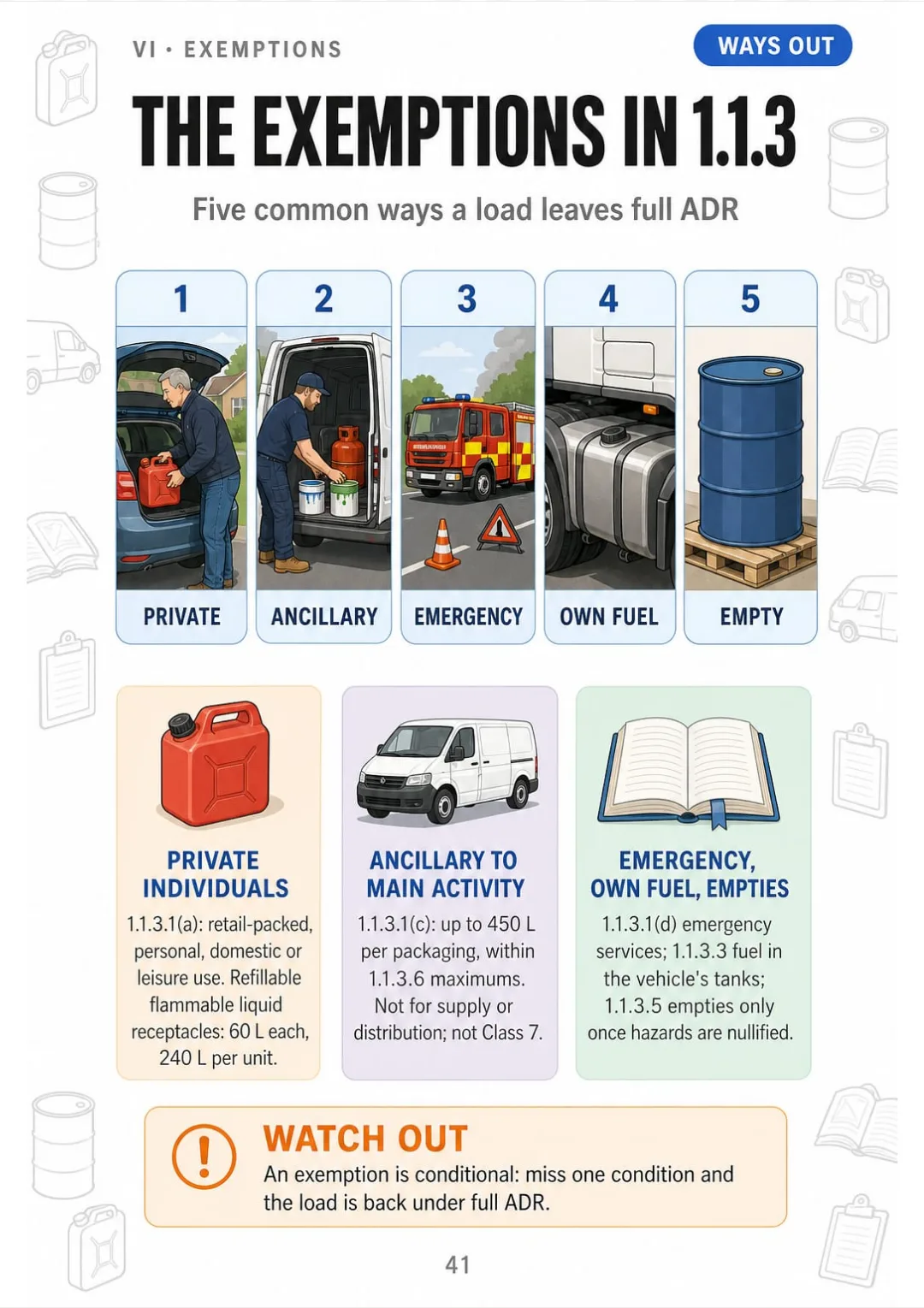
1.1.3.1: private individuals (60 L / 240 L) and ancillary carriage (450 L per packaging).
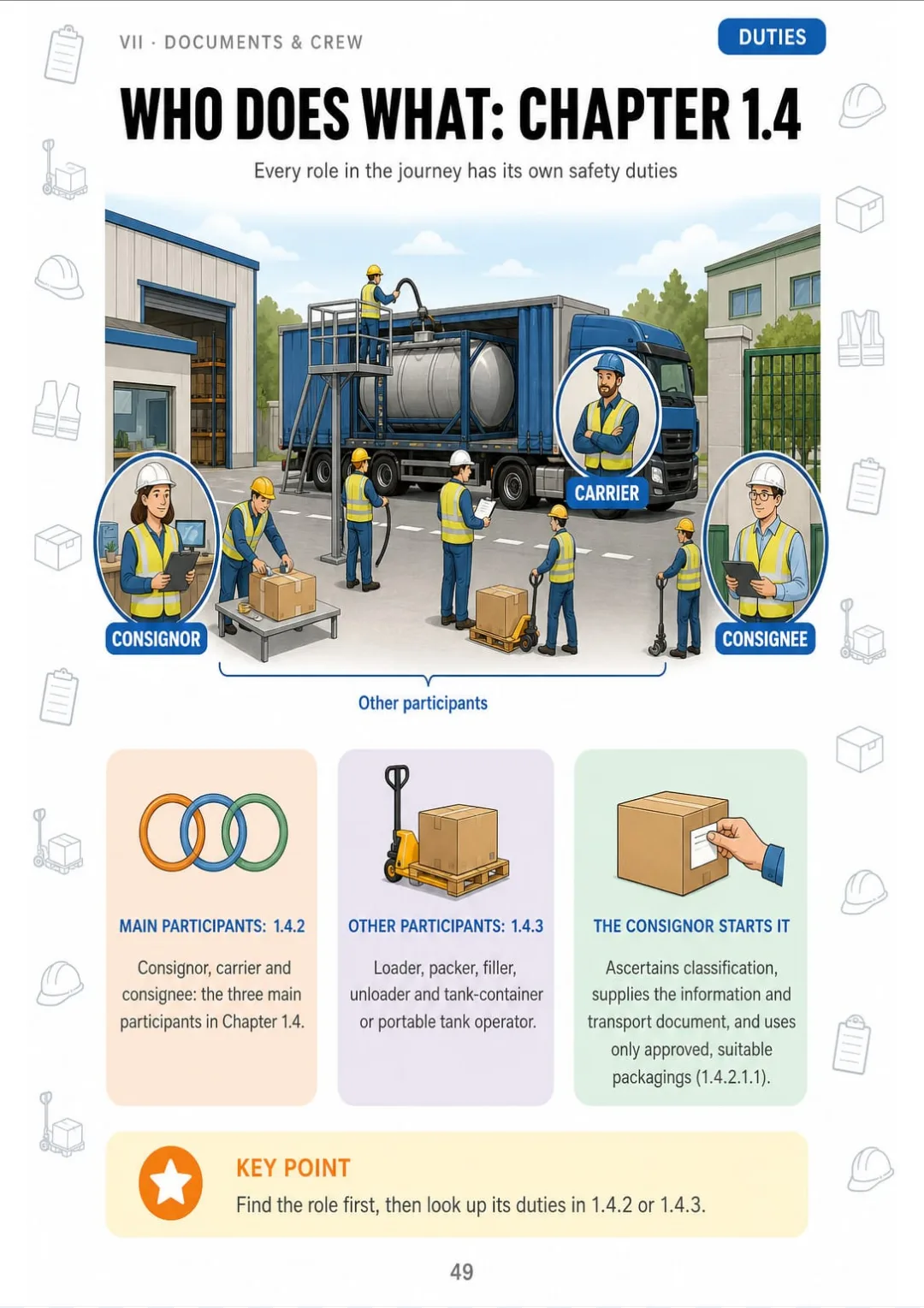
Chapter 1.4: consignor, carrier, consignee, plus loader, packer, filler, unloader and tank operator.
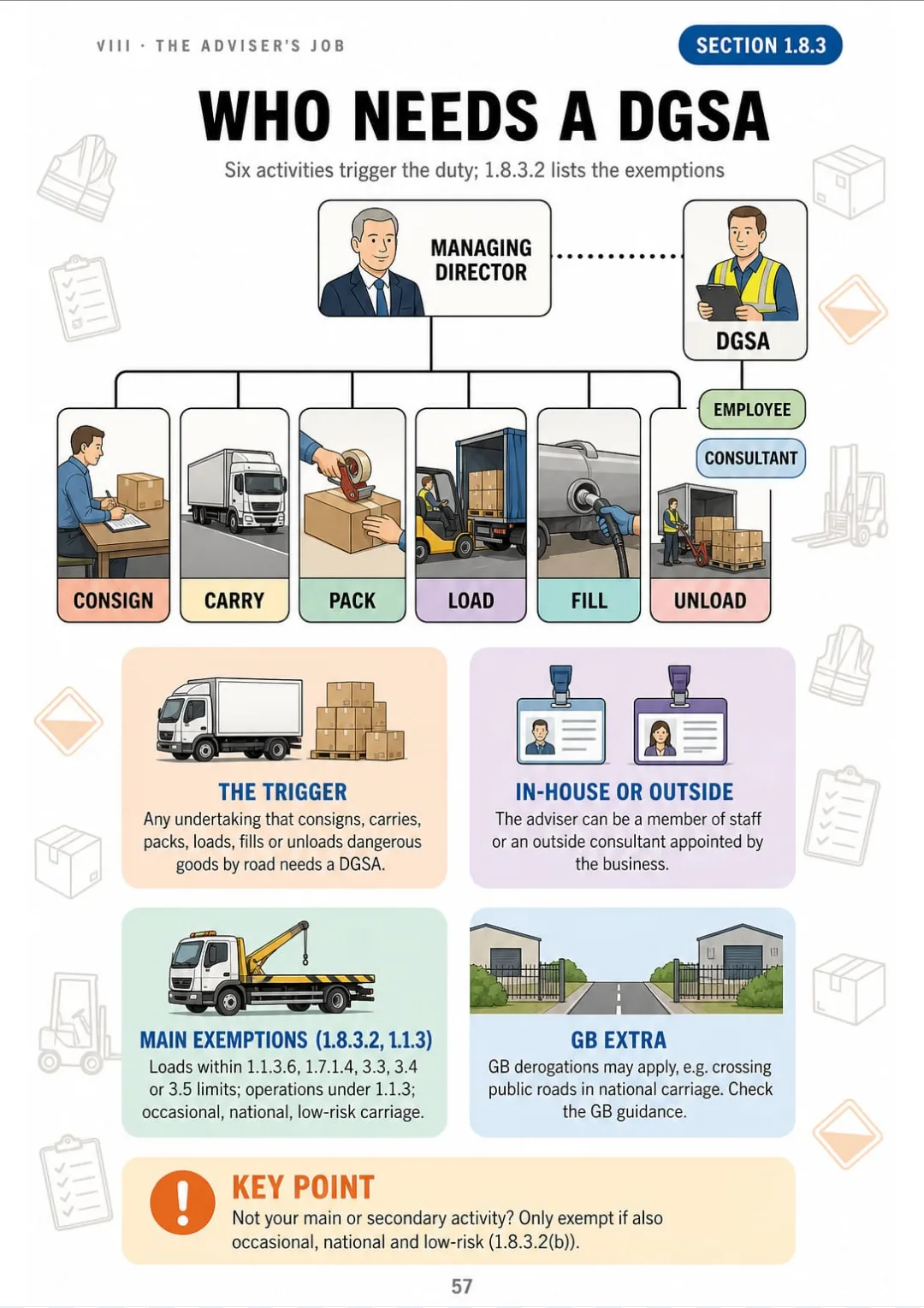
Consign, carry, pack, load, fill, unload: any one means you need a DGSA, unless 1.8.3.2 exempts you.

Swipe to see more →

These are real pages from the book. The table of contents is the full one: 9 parts and 64 topics.

The Problem Isn't You. It's How It Was Explained to You.

You're in the exam with a UN number and a question about its tunnel code. You open Table A and you're staring at 20 columns of codes, flicking back and forth while the clock runs.

ADR explains those columns in Chapter 3.2, in paragraph after paragraph of legal prose. Nothing on the page shows you which column sits where, so under time pressure the prose simply doesn't come back.

Table A columns 1 to 20, grouped: identity, packaging, tanks, carriage, emergency.

In this book, Table A is one page: the 20 columns split into 5 coloured blocks, identity, packaging, tanks, carriage and emergency. You see which block a column belongs to before you read a word.

The same goes for the 9 classes, the UN packaging mark, the orange plate, the 1.1.3 exemptions and the 1.1.3.6 points calculation: each one has its own page.

You go from UN number to answer column by column, without rereading the chapter to work out where to look.

COMPARE FOR YOURSELF

Same Topic, Two Ways to Study It

THIS
  • ADR: line after line of legal text
  • The 9 classes explained only in words
  • You reach the exam still unsure
The classes of dangerous goods according to ADR are the following: Class 1 Explosive substances and articles; Class 2 Gases; Class 3 Flammable liquids; Class 4.1 Flammable solids, self-reactive substances, polymerizing substances and solid desensitized explosives; Class 4.2 Substances liable to spontaneous combustion; Class 4.3 Substances which, in contact with water, emit flammable gases; Class 5.1 Oxidizing substances; Class 5.2 Organic peroxides; Class 6.1 Toxic substances; Class 6.2 Infectious substances; Class 7 Radioactive material; Class 8 Corrosive substances; Class 9 Miscellaneous dangerous substances and articles.
FOR THIS
  • The 9 classes on one board
  • Real examples in a box: petrol 3, LPG 2, lithium batteries 9
  • You see it and it makes sense
4.1 burns easily, 4.2 ignites in air, 4.3 gives off flammable gas with water.
CONTENTS

Take a Look at the 9 Parts and 64 Topics

The map of ADR, the 9 classes, the Dangerous Goods List, packaging and UN marks, labels and orange plates, exemptions and 1.1.3.6 points, documents and vehicle, the adviser's job and worked case studies: 68 pages, all illustrated.

IThe map of ADR · pp. 5-10
  1. ADR is a legal text, not a study book
  2. ADR's 9 parts on one page
  3. How to read an ADR reference
  4. ADR in Great Britain: CDG 2009
  5. The DGSA exam: Core and Road
  6. The 8-step route used throughout this book
IIClassification: the 9 classes · pp. 11-19
  1. The 9 classes on one board
  2. Class 1: divisions and compatibility groups
  3. Class 2: the gas codes
  4. Class 3: flash point and packing group
  5. Classes 4.1, 4.2 and 4.3 side by side
  6. Classes 5.1 and 5.2: oxidisers and organic peroxides
  7. Classes 6.1, 6.2, 7, 8 and 9
  8. Packing groups I, II and III
  9. Several hazards at once: the precedence table
IIIThe Dangerous Goods List · pp. 20-27
  1. Table A: the 20 columns on one page
  2. Columns 1 to 5: who the goods are
  3. Finding the right entry: Table B and N.O.S.
  4. Column 6: special provisions
  5. Columns 7a and 7b: LQ and EQ
  6. Columns 8, 9a and 9b: packing
  7. Column 15: transport category and tunnel code
  8. Columns 16 to 20: carriage and the orange plate
IVPackaging and UN marks · pp. 28-34
  1. Packaging words that sound alike
  2. Packaging codes: number and letter
  3. Reading a UN packaging mark
  4. Liquids vs solids on the mark
  5. Packing instructions: reading P001
  6. IBCs and large packagings
  7. Tank codes, letter by letter
VLabels, placards and orange plates · pp. 35-40
  1. Package labels and marks
  2. Placards on vehicles and containers
  3. The orange plate: plain or numbered
  4. Hazard identification numbers decoded
  5. Multi-compartment tankers
  6. Elevated temperature and environmentally hazardous marks
VIExemptions and 1.1.3.6 points · pp. 41-48
  1. The exemptions in 1.1.3
  2. 1.1.3.6: transport categories and maximum quantities
  3. What to count: kg, litres or water capacity
  4. The points calculation in 3 steps
  5. Worked mixed load: 1.1.3.6 points
  6. What still applies under 1,000 points
  7. Limited quantities
  8. Excepted quantities
VIIDocuments, crew and vehicle · pp. 49-56
  1. Who does what: the safety obligations in 1.4
  2. The transport document
  3. Instructions in writing
  4. The equipment on board
  5. Fire extinguishers by vehicle weight
  6. Driver training and the ADR certificate
  7. Mixed loading and segregation
  8. Tunnels and vehicle approval
VIIIThe adviser's job · pp. 57-62
  1. Who needs a DGSA: section 1.8.3
  2. The adviser's duties
  3. The annual report
  4. Accident reports: 1.8.3 and 1.8.5
  5. Security: Chapter 1.10
  6. The DGSA certificate and renewal
IXCase studies and revision · pp. 63-68
  1. The case study method in 8 steps
  2. Worked case: petrol tanker delivery
  3. Worked case: mixed packages on a 7.5 t van
  4. Worked case: limited quantity pallets
  5. Revision checklist: where each answer lives
  6. The most common mistakes, at a glance

One Page, One Topic, All Clear

Think of it this way:

A load is going out: cans of petrol and a few drums of corrosives on one van. Your manager asks a simple question: under the 1.1.3.6 limit, or orange plates?

In the book you open the 1.1.3.6 page and see the routine drawn in a row: transport category, multiplier, total against 1,000 points.

Package danger labels: diamond, normally at least 100 × 100 mm, line 5 mm inside the edge

Same with the Table A columns, the UN packaging mark, the orange plate, the transport document and the instructions in writing: each one on its own page.

DGSA Illustrated: Core & Road is 9 parts and 64 topics, all drawn, and it ends with worked case studies, a revision checklist and the most common mistakes at a glance.

What you see drawn, you don't have to memorize.

What's Inside DGSA Illustrated: Core & Road:

Ipp. 5-10

The map of ADR

Why ADR reads like law, its 9 parts on one page, how to read a reference, CDG 2009 and the 8-step route used throughout.

IIpp. 11-19

Classification: the 9 classes

The 9 classes on one board, Class 1 divisions, gas codes, flash points, packing groups and the precedence table.

IIIpp. 20-27

The Dangerous Goods List

You go from UN number to the right column: Table A's 20 columns in 5 blocks, Table B and N.O.S. entries, special provisions, LQ and EQ, packing, tunnel codes and the orange plate column.

IVpp. 28-34

Packaging and UN marks

Packaging words that sound alike, packaging codes, the UN mark for liquids and solids, P001, IBCs and tank codes.

Vpp. 35-40

Labels, placards and orange plates

Package labels and marks, placards, plain and numbered orange plates, hazard identification numbers and multi-compartment tankers.

VIpp. 41-48

Exemptions and 1.1.3.6 points

You decide plates or no plates with the 3-step points calculation: transport category, multiplier, total against 1,000. Plus the 1.1.3 exemptions, what to count, a worked mixed load, LQ and EQ.

VIIpp. 49-56

Documents, crew and vehicle

The safety obligations in 1.4, the transport document, instructions in writing, equipment, extinguishers, driver training, mixed loading and tunnels.

VIIIpp. 57-62

The adviser's job

Who needs a DGSA, the adviser's duties, the annual report, accident reports, security in 1.10 and certificate renewal.

IXpp. 63-68

Case studies and revision

The case study method in 8 steps, three worked cases, a revision checklist and the most common mistakes.

At the end of the book: Worked case studies in 8 steps, a revision checklist of where each answer lives and the most common mistakes at a glance.
Plus: 2 Free Books

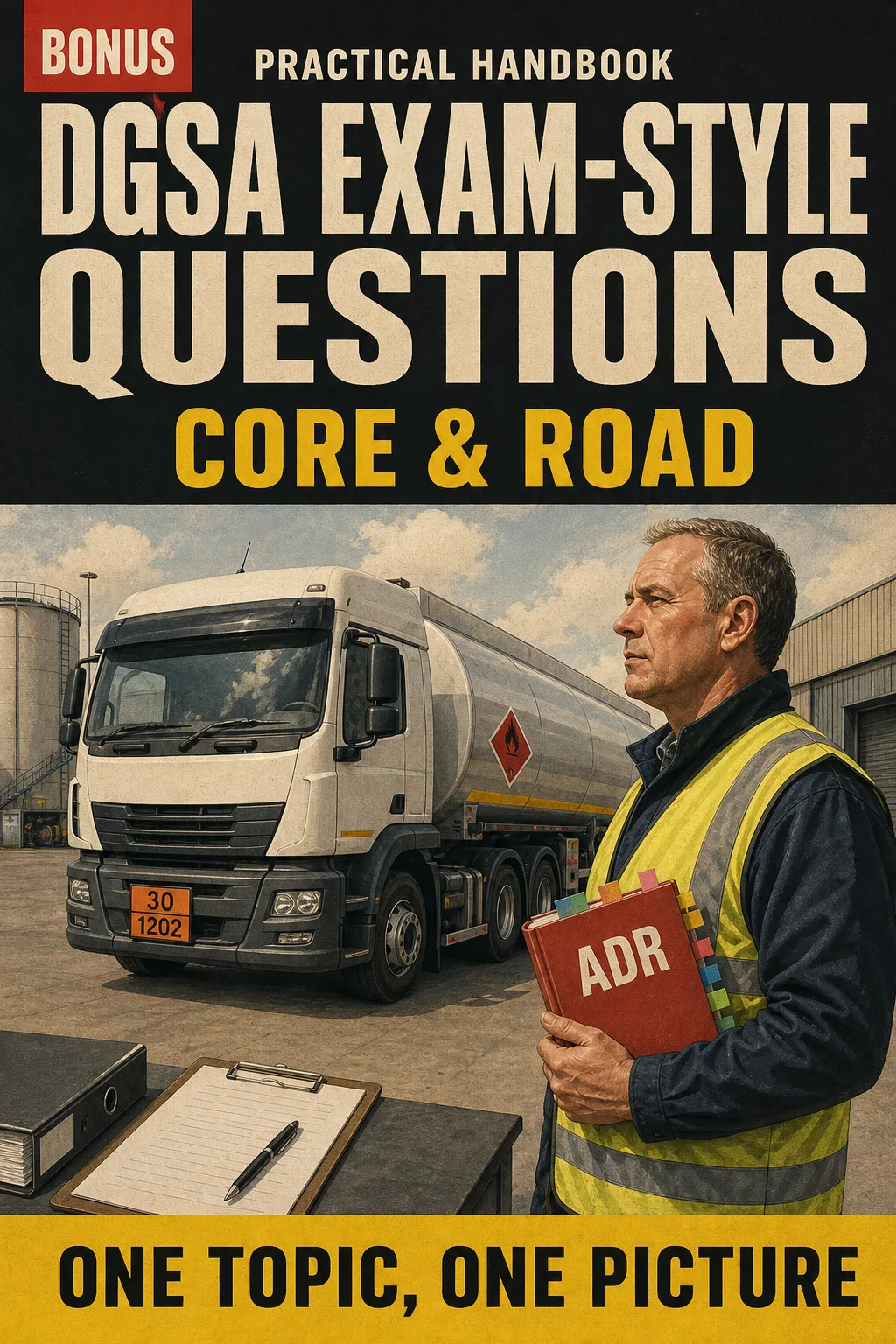
DGSA Exam-Style Questions: Core & Road

BONUS 1: «DGSA Exam-Style Questions: Core & Road»

Value on its own: US$ 17.90

Practise with exam-style questions and worked answers that show you exactly where in ADR each answer is found.

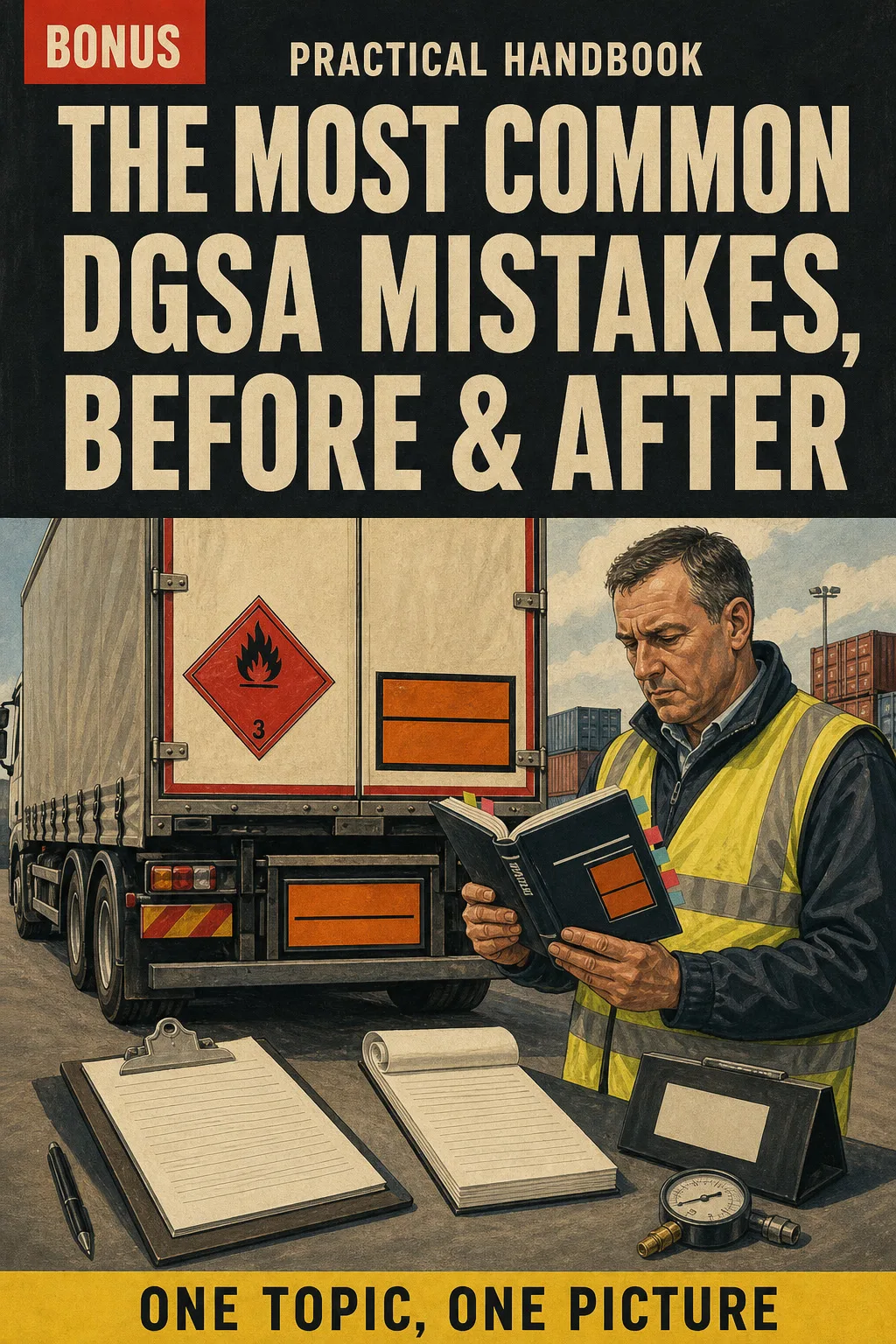
The Most Common DGSA Mistakes, Before & After

BONUS 2: «The Most Common DGSA Mistakes, Before & After»

Value on its own: US$ 14.90

See the most common mistakes in classification, points, placarding and paperwork, each one drawn next to the correct version, so you can revise them at a glance.

DGSA Illustrated: Core & Road with 2 Free Books

  • DGSA Illustrated: Core & Road: 68 illustrated pagesUS$ 63
  • BONUS 1: DGSA Exam-Style Questions: Core & RoadUS$ 17.90
  • BONUS 2: The Most Common DGSA Mistakes, Before & AfterUS$ 14.90
  • High-resolution PDF to printIncluded
Total value US$ 95.80
YOUR PRICE:
US$ 27
You save US$ 68.80
YES, I WANT DGSA ILLUSTRATED: CORE & ROAD FOR US$ 27

📄 This is a digital PDF book sent to your email: nothing is printed or shipped.

Secure purchaseEncrypted payment30-day guarantee

PDF by email: We email you DGSA Illustrated: Core & Road as a PDF, together with the two free books. It's a single payment: no installments, no extra charges.

Who This Book Is For

You're studying for Core and Road

You're studying for Core and Road

You learn the route through ADR first, then each rule in its place: class, Table A, packaging, labels, documents, exemptions.

Your exam date is close

Your exam date is close

The map of ADR and the revision checklist show you which part, chapter and column holds each answer, so you don't lose time searching.

You're already a DGSA and renewal is coming

You're already a DGSA and renewal is coming

You go back through the Core and Road topics one drawing at a time, checked against ADR 2025, so you know exactly which edition you're revising.

Everything You Get Today

US$ 95.80US$ 27
YES, I WANT DGSA ILLUSTRATED: CORE & ROAD FOR US$ 27

📄 This is a digital PDF book sent to your email: nothing is printed or shipped.

30DAYS
GUARANTEE

30-Day Guarantee

Try DGSA Illustrated: Core & Road for 30 days, bonus books included.

We refund everything if the file won't open, if the book isn't what you see here, if you were charged twice or if the email doesn't arrive. Just email us.

You pay once. No subscriptions.

Frequently Asked Questions

Is it for me if I've worked in transport for years and now my company needs me to be its DGSA?

Yes. It starts from the map of ADR and goes all the way to 1.1.3.6 points, the adviser's duties and worked case studies. It's visual, not basic.

Where does the content come from?

It's written for the UK DGSA exam, Core and Road modules. The content is checked against ADR 2025, the edition in force until the end of 2026, and the CDG Regulations 2009 as applied in Great Britain. ADR 2027 applies from 1 January 2027: if your exam is after that date, check which edition your course and exam centre use.

Is it official material?

No. It's an independent illustrated study book. It isn't issued or endorsed by SQA, any government department or UNECE, and it doesn't give you a certificate: the DGSA certificate comes only from passing the exam.

Does it replace the course or ADR itself?

No. It's a study companion to use alongside your training and the official ADR text, which always takes precedence. In the exam you'll work from ADR itself, so check with your exam centre what you can take in. This book is for learning where to look in ADR before you get there.

Are the practice questions the ones from the exam?

No. The exam-style questions are written for this book to help you practise. They aren't official exam questions.

When and how do I get it?

The book and the 2 gifts arrive as a PDF by email, at the address you enter at checkout.

Do I have to pay every month?

No. It's a one-off payment, with no subscription.

Can I have it on paper?

Yes. The PDF prints at home or at any print shop, so you can keep it next to your copy of ADR.

How does the refund work?

You have 30 days. We refund everything if the file won't open, if the book isn't what you see on this page, if you were charged twice or if the email doesn't arrive: just email us.

Before You Close This Page

No more rereading ADR with nothing sticking.

Table A's 20 columns, drawn in 5 blocks you can picture.

You walk into the exam knowing which part of ADR to open.

Drawings make studying faster.

The book is right below.

One-time payment: US$ 27 · Guarantee: 30 days · PDF by email

YES, I WANT DGSA ILLUSTRATED: CORE & ROAD FOR US$ 27

📄 This is a digital PDF book sent to your email: nothing is printed or shipped.